Connect with us

World News

More Than 18 Lakh Indian Accounts Banned by ‘Whatsapp’ In March 2022.

Published

on

14.26 lakh Indian accounts banned by WhatsApp in Feb

Khushi Shah – Mumbai Uncensored, 3rd May 2022

India is one of the major markets of WhatsApp with more than 400 million users. It is one of the most used ways to exchange text, image, video or document file with another person and business.

WhatsApp has been working on introducing features to enhance engagement on the platform. It has banned 18.05 lakh Indian accounts in March, on the basis of complaints from 597 grievance reports that were received from users between March 1-31, 2022 using the “abuse detection approach, which also includes action taken in furtherance to negative feedback received from users.

This was based on the new IT rules which came into effect last year that require large digital platforms (with over 50 lakh users) to publish compliance reports every month, mentioning the details of complaints received and action taken. This user-safety report contains details of the user complaints received and the corresponding action taken by WhatsApp, as well as WhatsApp’s own preventive actions to combat abuse on their platform. 

In March 2022 after 597 grievance reports were received, and 74 accounts were “actioned” and 407 pertained to ‘ban appeal’ while others were in the categories of account support, product support and safety, among others.

“In accordance with the IT Rules 2021, we’ve published our report for the month of March 2022. This user-safety report contains details of the user complaints received and the corresponding action taken by WhatsApp, as well as WhatsApp’s own preventive actions to combat abuse on our platform,” – A statement by a WhatsApp spokesperson.

Over the years several warnings have been issued against ‘Whatsapp’, in the wake of killings taking place across the country due to rumours that circulate through the app. The abuse of a platform like WhatsApp for repeated circulation of such provocative content has been of deep concern. The platform has consistently invested in Artificial Intelligence and other state-of-the-art technology, data scientists and experts, and in processes, in order to keep users safe.

These abusive accounts accounts were possibly banned for being involved in harmful activities such as harassment, forwarding fake information, duping other users, and more.WhatsApp over the last few years has also introduced several new features for limiting the spread of fake information on the platform including limiting forwarding messages, and more.

The company explains that abuse detection at WhatsApp operates at three stages of an account’s lifestyle: at registration, during messaging, and in response to negative feedback, which it receives in the form of user reports and blocks.

World News

Trump Brokers Fragile Ceasefire Between Israel and Iran; India Navigates Diplomatic Crossroads

Published

on

ceasefire 1

In a dramatic turn of events, former U.S. President Donald Trump announced he had brokered a ceasefire between Israel and Iran following nearly two weeks of escalating military conflict. The announcement came after a series of U.S.-assisted Israeli airstrikes targeting Iranian nuclear facilities. While the strikes reportedly set Iran’s enrichment capability back by a few months, both nations claimed limited damage and victory. Trump’s move to publicly declare peace has stirred both praise and criticism on the global stage, especially as skirmishes have continued sporadically despite the ceasefire.

For India, the implications of the de-escalation are wide-ranging and complex. As a nation heavily reliant on West Asian oil and a major stakeholder in regional infrastructure corridors, India has welcomed the ceasefire cautiously but remains alert. The Indian government, consistent with its longstanding diplomatic neutrality in Middle Eastern affairs, avoided direct commentary on either nation’s military actions but reiterated its call for regional peace and restraint.

Strategically, the ceasefire offers India a short-term relief in crude oil market volatility. Earlier fears of oil price spikes and disrupted shipping through the Strait of Hormuz had already triggered conversations about contingency energy sourcing. With tensions momentarily defused, India hopes to preserve price stability and avoid further strain on its import-dependent economy.

India’s other key concern lies in regional trade infrastructure. The India–Middle East–Europe Economic Corridor (IMEC), touted as a counter to China’s Belt and Road Initiative, depends on stable Middle Eastern partners. Any renewed conflict could stall or even derail portions of this project, particularly if Iran were to reactivate proxy conflicts through Iraq or Syria.

On the intelligence front, India is closely monitoring fallout from Trump’s public disclosures related to the strikes. Sensitive operational leaks have reportedly irked U.S. allies, raising broader concerns about the handling of strategic information. With India deepening its intelligence ties with both Israel and the U.S., preserving trust within these networks is paramount.

In the long run, India’s approach will remain pragmatic: focused on de-risking its energy lifelines, safeguarding its economic corridors, and maintaining careful neutrality in one of the world’s most volatile geopolitical theatres.

Continue Reading

World News

India and Malaysia Elevate Bilateral Ties to Comprehensive Strategic Partnership

Published

on

pm modi 200305214

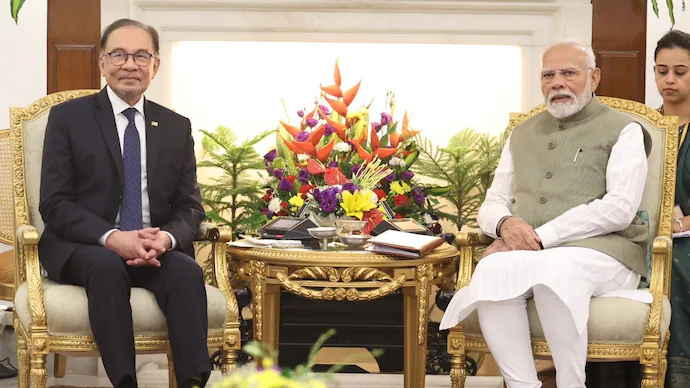
In a significant diplomatic development, India and Malaysia have decided to elevate their bilateral relationship to a Comprehensive Strategic Partnership following high-level talks between Indian Prime Minister Narendra Modi and Malaysian Prime Minister Anwar Ibrahim. The decision was formalized during a three-day visit by Prime Minister Ibrahim to India, marking his first official visit to the country since taking office.

Ceremonial Welcome at Rashtrapati Bhavan:

Prime Minister Narendra Modi warmly welcomed his Malaysian counterpart at Rashtrapati Bhavan on Tuesday, where a ceremonial reception was held in his honor. The two leaders then engaged in extensive discussions aimed at deepening cooperation across a broad spectrum of areas, particularly in trade, investment, and emerging technologies.

Key Agreements and Areas of Cooperation:

A series of bilateral agreements were signed, including a crucial pact on the employment and repatriation of workers and another focusing on boosting cooperation in digital technologies. The agreements are seen as vital steps in fostering closer economic ties between the two nations.

One of the most notable outcomes of the talks was the decision to work towards linking India’s Unified Payments Interface (UPI) with Malaysia’s PayNet system, which is expected to facilitate smoother financial transactions and further integrate the two economies.

Focus on Trade, Investment, and Defense:

Expanding trade and investment was a major focus of the Modi-Ibrahim talks. Prime Minister Modi highlighted the untapped potential in the economic relationship between India and Malaysia, particularly in new and emerging sectors. The leaders also discussed the timely review of the free trade agreement between India and the Association of Southeast Asian Nations (ASEAN), of which Malaysia is a key member.

In addition to economic cooperation, the two sides explored new possibilities in the defense sector, reflecting a mutual interest in enhancing security collaboration. The leaders also reaffirmed their shared commitment to combating terrorism and extremism, emphasizing the importance of peace and stability in the Indo-Pacific region.

Commitment to Regional Stability:

Prime Minister Modi underscored India’s commitment to the principles of freedom of navigation and overflight in accordance with international law, a statement that appeared to address the ongoing disputes in the South China Sea. Both leaders expressed their preference for resolving disputes peacefully, further reinforcing their commitment to regional stability.

Strengthening ASEAN-India Ties:

Modi also described Malaysia as a critical partner for India within the ASEAN and Indo-Pacific frameworks. The discussions between the two leaders reinforced the strategic importance of the ASEAN-India relationship and the need for timely updates to the existing free trade agreement to better reflect the current economic realities.

Conclusion:

The elevation of India-Malaysia ties to a Comprehensive Strategic Partnership marks a new chapter in the relationship between the two countries. With agreements on key issues such as digital cooperation and worker repatriation, along with a shared vision for regional stability, the visit of Prime Minister Anwar Ibrahim has set the stage for deeper and more comprehensive collaboration in the years to come.

Continue Reading

World News

Behind the Headlines: Understanding the Challenges of the Israel-Palestine Two-State Proposal

Published

on

SR 23.09.26 Israel peace feature

Manak Sharma, Mumbai Uncensored, 28th November, 2023:

THE TWO-STATE SOLUTION

The two-state solution is believed to be the only possible way to end the conflict between Israel and Palestine. The solution proposes two separate states, Israel for the Jewish people and Palestine (including both Gaza and West Bank) for the Palestinian people. The solution is designed on the basis that both the states have the legal right to decide their own destiny in the international order. Both Israel and Palestine will share Jerusalem as their capital city. The border between the two states will be based upon the 1967 border before the third Arab-Israel war. In a fair and equitable manner, Palestinian refugees settled in different parts of the world will be allowed to return.

Since 1947, the United Nations has stated the two-state solution as its official policy but it has failed to be implemented and the Israel-Palestine conflict continues. Many countries around the world have endorsed the two-state solution including Qatar which is mediating between Hamas and Israel.

PROBLEMS IN IMPLEMENTATION

There are mainly three reasons why the two-state solution has failed to be implemented. First, both countries do not agree on the border of Palestine in future. Second, with the Israeli government building settlements continuously in occupied Palestinian territories, it becomes difficult to create a Palestinian state which will share the border with Israel. Third, the two-state solution does not clarify how the millions of Palestinian refugees living all around the world will be able to return to their country. Palestinian authorities will not agree to any solution which fails to address the issue of Palestinian refugees returning home.

CONCLUSION

The two-state solution might be complex and difficult to achieve but it is the only viable option to establish peace in the region and end the conflict which is causing hundreds of casualties daily since Hamas attacked Israel on October 7th this year.  The international community rather than instigating the war further, needs to mediate between the two countries encouraging them to make necessary compromises and agree on the two-state solution.  The two countries reaching a solution seems difficult but the four-day truce which will make both the IDF and Hamas return civilians taken as captives shows a ray of hope that the Israeli government and Hamas will agree to some deal and stop the war in near future.

Continue Reading

Trending